AI Consulting Playbook
From an AI opportunity to a governed decision and clean handoff
Michael Long, surfaces.systems
October 1, 2026 · Version 1.0.0
Next version review
Site + PDF
Scheduled for .
Site and PDF updates publish together after manual review.
Contents
- How to use this playbook
- Choose a path
- What you need
- The consulting loop at a glance
- The consulting packet you will build
- Frame the engagement around a decision
- See the work as it actually happens
- Choose one opportunity worth testing
- Define the future workflow and AI boundary
- Make ownership, risk, and permissions explicit
- Design a pilot that can answer a decision
- Plan delivery around uncertainty
- Build and verify the whole pilot system
- Prepare the people who will use and support it
- Run the pilot as a controlled evidence loop
- Turn the evidence into the next decision
- Leave the client able to continue
- Guided capstone: Harborline decision review
- Guided capstone answer key
- Guided capstone self-assessment
- Appendix A: consulting lifecycle
- Appendix B: discovery interview and observation guide
- Appendix C: assist, recommend, decide, and act
- Appendix D: measurement and economics cheat sheet
- Appendix E: governance and vendor question bank
- Appendix F: plain-language glossary
- Appendix G: worksheet index
- Further reading and source notes
How to use this playbook
AI consulting starts with a request that is usually too broad: find the use cases, automate the work, choose a platform, or get the company ready. This playbook supplies the operating layer between that request and a defensible decision. It treats consulting as evidence work carried through delivery, adoption, and ownership transfer.
For: independent consultants, product and design leaders, transformation teams, technical advisors, and internal AI leads. The playbook assumes basic familiarity with AI products but does not require model training or production engineering expertise.
Choose a path
PATH | TIME | WHAT TO DO | OUTCOME |
|---|---|---|---|
Orientation | 90 minutes | Read the concepts and worked examples; skip blank worksheets. | You can frame a better AI engagement and challenge a weak pilot. |
Practice | 6-8 hours | Complete one worksheet in every module. | You can draft a credible consulting packet. |
Full field guide | 12-15 hours plus capstone | Complete the exercises, worksheets, capstone, and decision memo. | You can make and defend a bounded recommendation and handoff. |
The repeated learning loop
Rejoin the Harborline Service Operations case.
Learn one consulting move in plain language.
See the decision rule, model, or artifact that makes the move inspectable.
Apply it in a short exercise and compare your answer.
Complete a worksheet that carries into the next module.
End with the claim the artifact supports and the boundary it does not cross.
What you need
This PDF, a pen or note-taking app, and access to the people who perform or receive the work.
For a real engagement: the sponsor request, current workflow, service or product measures, policies, data inventory, vendor commitments, and responsible owners.
Permission to observe the work and test assumptions. Interviews alone rarely expose queues, workarounds, exception handling, or unrecorded review burden.
A place to keep a decision log, evidence ledger, risk register, and versioned deliverables.
Sources were reviewed on October 1, 2026. Harborline, its data, the consulting sequence, rating labels, exercises, and templates are fictional examples or author synthesis. Regulatory dates are a snapshot, not a substitute for current legal review.
The consulting loop at a glance
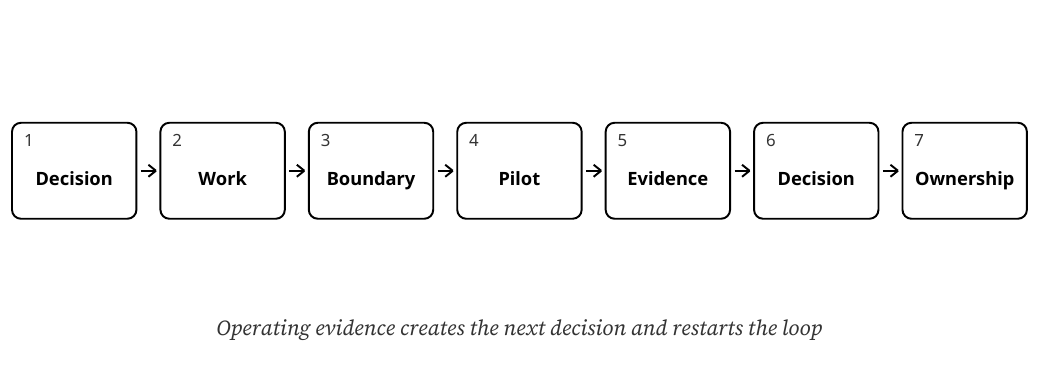
A consulting engagement starts with a decision, not an AI feature. The team observes the work, defines the boundary, runs a controlled pilot, interprets the evidence, and chooses the next action. Ownership then shifts into the client operating system. New production evidence creates the next decision.
- Decision
- Work
- Boundary
- Pilot
- Evidence
- Decision
- Ownership
Operating evidence creates the next decision and restarts the loop
Diagram relationships
- Decision → Work
- Work → Boundary
- Boundary → Pilot
- Pilot → Evidence
- Evidence → Decision
- Decision → Ownership
- Ownership → Decision (feedback)
The recurring case: Harborline
Harborline is a fictional regional commercial-equipment maintenance company. Service coordinators receive requests through email, phone, and a customer portal. They identify the account and equipment, assess urgency, search manuals and contracts, and create a work order. Safety, technician certification, geography, parts, and service-level commitments complicate dispatch.
The COO asks the consulting team to 'automate dispatch with AI.' Field evidence points to a narrower first move: structure intake, retrieve approved evidence, and draft a work order for coordinator review. Priority changes, technician assignment, customer commitments, and autonomous writes remain outside the first pilot.
The consulting packet you will build
MODULES | PACKET |
|---|---|
1-3 | Engagement decision brief, current-state evidence, opportunity recommendation. |
4-5 | Target workflow, AI boundary, risk controls, permissions, governance map. |
6-8 | Pilot charter, integrated delivery plan, system manifest, readiness evidence. |
9-10 | Change-impact plan, training and support, weekly evidence board, incident loop. |
11-12 | Outcome scorecard, decision memo, operating runbook, ownership and handoff record. |
Five rules for the full guide
Do not turn a sponsor request into a solution before observing the work.
Do not collapse business impact, system quality, risk, and adoption into one score.
Do not let a prompt serve as the control for permissions, money, safety, privacy, or irreversible actions.
Do not call a pilot successful unless it changes a named decision against predeclared evidence.
Do not call delivery complete until named owners accept the system, evidence, runbooks, and review cadence.
Frame the engagement around a decision
Turn a broad AI request into a bounded question with an owner, evidence standard, and decision date.

Learning objectives. You will separate the sponsor's stated request from the decision the organization needs to make; name scope, non-goals, owners, assumptions, and evidence; and set an engagement boundary that can survive new ideas without quietly expanding.
The request is usually not the decision
'Find our AI use cases' names an activity. 'Automate dispatch' names a preferred answer. Neither tells the team what decision must be made, by whom, or from what evidence. A useful engagement brief translates the request into a question that can produce an action.
SPONSOR SAYS | DECISION THE ENGAGEMENT COULD SUPPORT | EVIDENCE NEEDED |
|---|---|---|
Find our AI use cases | Which one or two workflow changes deserve a bounded pilot this quarter? | Observed work, baseline, alternatives, dependencies, value, risk. |
Choose an AI platform | Which capability and operating model fit the named workflow and constraints? | Requirements, security and data posture, tests, cost, exit terms. |
Automate dispatch | What is the smallest safe change that reduces intake delay without weakening safety or accountability? | Workflow evidence, exceptions, control points, pilot measures. |
Create an AI strategy | Which decisions, capabilities, and governance routines should the organization fund next? | Portfolio evidence, maturity gaps, operating constraints, owners. |
Write the decision before the workplan
Name the decision and the person accountable for making it.
Name the workflow, users, business boundary, and jurisdictions in scope.
State the choices that could follow: stop, repair the process, automate conventionally, pilot AI, buy, build, or defer.
Define the evidence the decision owner considers sufficient and the date the decision is due.
List non-goals and prohibited assumptions so discovery cannot silently convert them into commitments.
Record who may change scope, how the change will be evaluated, and what it does to time, cost, and evidence quality.
A decision brief has six parts
PART | QUESTION IT ANSWERS | COMMON FAILURE |
|---|---|---|
Decision | What action will this work support? | A deliverable replaces a decision. |
Owner | Who can accept the recommendation and its risk? | The sponsor is influential but not accountable. |
Boundary | Which workflow, population, locations, systems, and actions are included? | A promising demo becomes an enterprise claim. |
Evidence | What observations, measures, tests, and approvals are needed? | Opinion and workshop enthusiasm are treated as proof. |
Timing | When must the decision be made, and what can be learned by then? | The schedule assumes evidence that cannot be collected. |
Non-goals | What will the engagement deliberately not establish? | Unasked strategy, architecture, or compliance work appears later. |
Protect engagement integrity
Disclose vendor relationships, referral fees, platform incentives, and reusable intellectual property that could shape a recommendation.
Separate facts supplied by the client, observations made by the team, external sources, and consultant synthesis.
Do not use client data in unapproved tools or promise that a provider contract, setting, or model behavior satisfies a legal duty.
Record material disagreements and uncertainty. A clean narrative is not worth erasing a real decision risk.
Make acceptance criteria visible before the final presentation, not while the recommendation is being negotiated.
Exercise: rewrite the Harborline request
The COO asks, 'Can you automate dispatch with AI before peak season?' Write a decision, owner, scope, and non-claim that would let discovery find a narrower answer.
Worksheet 1: engagement decision brief
ENGAGEMENT DECISION BRIEF | |||||
|---|---|---|---|---|---|
| |||||
| |||||
| |||||
| |||||
| |||||
| |||||
| |||||
|
Sources: C1, C3-C5, C16, C18. The consulting sequence, worksheets, and Harborline case are author synthesis. Full citations appear in Further reading.
See the work as it actually happens
Observe the actors, evidence, queues, handoffs, and exceptions that determine the real opportunity.

Learning objectives. You will map current work from evidence rather than policy alone, establish a usable baseline, distinguish normal flow from exception work, and separate an observed finding from an interpretation or recommendation.
The documented process is one source
A procedure explains how work is supposed to move. Interviews explain how people understand it. Logs and records show some of what the systems captured. Observation exposes switching, copying, waiting, review, workaround, and recovery that neither the procedure nor the logs may contain. Use the sources together.
EVIDENCE | BEST FOR | MAIN LIMITATION |
|---|---|---|
Policy and procedure | Required sequence, roles, controls, official exceptions. | May lag practice or omit local workarounds. |
Interview | Intent, judgment, pain, trust, incentives, unrecorded history. | Recall and social desirability can distort frequency. |
Observation | Actual sequence, tool switching, hidden review, exception handling. | A small sample can overrepresent unusual days. |
System logs | Volume, timestamps, transitions, errors, repeated behavior. | A log records what was instrumented, not the whole experience. |
Work artifacts | Inputs, outputs, quality defects, provenance, rework evidence. | Retention and privacy constraints may limit access. |
Outcome data | Service, financial, quality, safety, or user consequence. | Confounding and missing baselines weaken attribution. |
Map the unit of work
Choose a unit that can be followed from entry to outcome: one service request, claim, support conversation, inspection, planning cycle, or invoice exception. For each unit, record the actor, input, decision, evidence, tool, handoff, wait, exception, output, and consequence.
FIELD | HARBORLINE OBSERVATION |
|---|---|
Entry | Email, phone note, or portal request arrives with inconsistent detail. |
Interpretation | Coordinator identifies account, equipment, symptom, urgency, and contract. |
Evidence search | Manuals, prior work orders, customer contract, parts and certification data. |
Decision | Create request, ask for missing information, escalate safety concern, or prepare dispatch. |
Handoff | Coordinator to service supervisor, scheduler, technician, or customer. |
Exception | Unknown serial number, conflicting urgency, stale manual, missing contract, safety phrase. |
Outcome | Complete work order, rework, delay, escalation, wrong commitment, or prevented error. |
Build a baseline that matches the decision
Volume: eligible units, arrival pattern, seasonality, and important slices.
Time: active work, elapsed time, waiting, review, and recovery time.
Quality: complete-first-time rate, rework, escalation, defects, and downstream correction.
Service and user outcome: time to resolution, missed commitment, satisfaction, safety, or burden.
Economics: labor, platform, vendor, support, review, incident, and opportunity cost.
Control and risk: access exceptions, policy overrides, privacy events, near misses, and audit gaps.
Keep facts, interpretations, and proposals separate
TYPE | EXAMPLE | HOW TO RECORD IT |
|---|---|---|
Observed fact | 14 of 30 observed requests required a second system lookup after the work order was opened. | Source, sample, period, unit, and exact count. |
Participant report | Coordinators say contract lookup is the least predictable step. | Speaker role, context, and whether the theme repeated. |
Interpretation | Fragmented evidence may be a stronger constraint than dispatch logic. | Reasoning and alternative explanations. |
Proposal | Test retrieval and drafting before automated assignment. | Expected outcome, risk, evidence plan, and owner. |
Exercise: find the hidden work
A process map shows a two-minute 'create work order' step. Observation shows coordinators spend another seven minutes locating the contract, resolving serial-number differences, and rewriting customer language. What belongs in the baseline?
Worksheet 2: current-state evidence
CURRENT-STATE EVIDENCE SHEET | ||||||
|---|---|---|---|---|---|---|
| ||||||
| ||||||
| ||||||
| ||||||
| ||||||
| ||||||
| ||||||
|
Sources: C16-C19. The consulting sequence, worksheets, and Harborline case are author synthesis. Full citations appear in Further reading.
Choose one opportunity worth testing
Compare AI with process repair, conventional automation, and no change before selecting a pilot.

Learning objectives. You will generate alternatives from workflow evidence, classify the proposed role of AI, compare value, feasibility, risk, and readiness, and recommend one bounded opportunity without pretending a workshop score is proof.
Start with alternatives, not use cases
A strong opportunity review asks what change would improve the workflow. AI is one possible mechanism. Process repair, better data, clearer policy, search, rules, integration, staffing, or no change may be stronger. Include those options before a favored solution gathers momentum.
OPTION | HARBORLINE EXAMPLE | WHEN IT MAY BE STRONGER |
|---|---|---|
Process repair | Require serial number and safety indicator at intake. | The main failure is missing or inconsistent input. |
Conventional automation | Validate account and contract fields; route by deterministic rules. | Rules are stable, observable, and exact. |
Search and information design | Unify approved manuals and contract lookup. | People need attributable evidence more than generation. |
AI assistance | Structure intake and draft a work order from approved evidence. | Language varies but a human can review the result. |
AI recommendation | Suggest priority or technician candidates. | Judgment can be evaluated and a responsible human decides. |
AI action | Assign technician and commit to customer timing. | Only after authorization, safety, recovery, and accountability are strong. |
No change or defer | Keep current process while fixing data ownership. | Dependencies prevent useful learning or the risk is disproportionate. |
Classify the role before scoring the idea
ROLE | SYSTEM BEHAVIOR | HUMAN RESPONSIBILITY | TYPICAL EXPOSURE |
|---|---|---|---|
Assist | Draft, summarize, retrieve, transform, or flag. | Review and complete the work. | Low to moderate when actions stay reversible. |
Recommend | Rank or propose a decision. | Understand evidence, decide, and record override. | Depends on consequence and review quality. |
Decide | Select an outcome within policy. | Oversee exceptions and challenge outcomes. | High when rights, safety, money, or access are affected. |
Act | Change an external system or communicate a commitment. | Authorize, monitor, reconcile, and recover. | Highest when actions are consequential or hard to reverse. |
Screen each option against evidence
DIMENSION | QUESTIONS | EVIDENCE |
|---|---|---|
Outcome value | Which user or business outcome changes? How much does the problem matter? | Baseline, outcome data, affected volume, decision owner. |
Workflow fit | Does the proposed behavior fit the real task, exception rate, and review path? | Observation, task analysis, error and recovery paths. |
Technical feasibility | Can the complete system meet quality, latency, integration, and reliability needs? | Prototype, representative tests, architecture constraints. |
Data and knowledge | Are permitted, current, attributable inputs available? | Inventory, access rules, provenance, quality samples. |
Risk and rights | Who can be harmed or excluded? Which duties and controls apply? | Impact assessment, legal/risk review, affected-person input. |
Adoption readiness | Will roles, workload, skills, trust, and support permit use? | Role map, capacity, incentives, prior change history. |
Economics | What is the full cost to build, run, review, govern, and exit? | Baseline cost, vendor terms, staffing and sensitivity model. |
Use High when observed evidence supports the rating, Medium when a material dependency remains, and Low when evidence shows a poor fit or a prerequisite is missing. Use Unknown when evidence is absent. Record the facts behind value and readiness separately; do not add the labels into a single score. These labels organize a discussion, not an investment calculation.
Show the reasoning behind one rating
Harborline's structured intake has High value because missing serial, contract, and safety fields repeatedly cause rework. Readiness is High only for validating required fields in the two observed queues, where Operations owns the field policy. Mandatory portal fields are the conventional alternative. Approved evidence retrieval has High value but Medium readiness because source owners, dates, and contract labels need repair. The recommendation is to test intake and retrieval together only after those dependencies close. These are fictional case judgments, not market benchmarks.
Rank Harborline's first opportunities
OPPORTUNITY | VALUE | READY | RECOMMENDATION |
|---|---|---|---|
Structured intake | High | High | Include |
Approved evidence retrieval | High | Medium | Include after access and freshness work |
Work-order drafting | High | Medium | Include with coordinator approval |
Priority recommendation | Medium | Low | Challenge separately |
Autonomous assignment | Unknown | Low | Exclude from first pilot |
Exercise: challenge the workshop winner
A workshop ranks autonomous technician assignment first because leaders expect the largest savings. Data ownership, safety exceptions, scheduling permissions, and recovery are unknown. What should the recommendation say?
Worksheet 3: opportunity recommendation
OPPORTUNITY RECOMMENDATION | ||||||
|---|---|---|---|---|---|---|
| ||||||
| ||||||
| ||||||
| ||||||
| ||||||
| ||||||
| ||||||
|
Sources: C1-C5, C16-C19, C25. The consulting sequence, worksheets, and Harborline case are author synthesis. Full citations appear in Further reading.
Define the future workflow and AI boundary
Specify what changes, what stays human, what data and actions are permitted, and how the work fails safely.

Learning objectives. You will design the future workflow around a complete service, write a behavior and outcome contract, set the AI boundary, define meaningful human review, and connect the proposed change to a testable value hypothesis.
Design the service, not the model call
The future workflow includes intake, identity, data access, context, model behavior, interface, review, approval, tool execution, logging, fallback, support, and recovery. A useful boundary names every point where responsibility or state changes.
STAGE | HARBORLINE FUTURE FLOW | CONTROL |
|---|---|---|
Admit | Coordinator opens an eligible request from one of two pilot queues. | Queue, user, region, and request type are checked. |
Structure | Assistant extracts account, equipment, symptom, urgency cues, and missing fields. | Source text remains visible; missing data is not invented. |
Retrieve | System fetches approved manual and contract passages. | Identity, access, version, date, and citation travel with evidence. |
Draft | Assistant proposes a work order and questions for the customer. | No priority, assignment, commitment, or external write. |
Review | Coordinator compares draft with source request and cited evidence. | Editable fields, reasons, uncertainty, and unsupported claims are visible. |
Commit | Coordinator corrects and submits through the existing system. | Existing authorization, audit, and confirmation remain authoritative. |
Recover | System degrades to current workflow when evidence or service is unavailable. | No partial hidden state; issue is visible and traceable. |
Write a behavior and outcome contract
The contract names behavior, outcome, exclusions, and fallback in language that product, engineering, operations, evaluation, risk, and users can inspect together. It should be specific enough to generate tests and workflow measures.
Make the boundary explicit
BOUNDARY | PERMITTED | EXCLUDED IN FIRST PILOT |
|---|---|---|
Users | Named coordinators and supervisors in two queues. | Technicians, customers, contractors, and other regions. |
Data | Approved request, account, contract, manual, and prior-work-order fields. | Unapproved email, personal folders, unrelated customers, hidden credentials. |
Outputs | Structured intake, missing questions, citations, draft work order. | Final safety decision, customer promise, legal interpretation. |
Actions | Save a draft in pilot workspace after coordinator confirmation. | Production write, priority change, assignment, message, purchase, refund. |
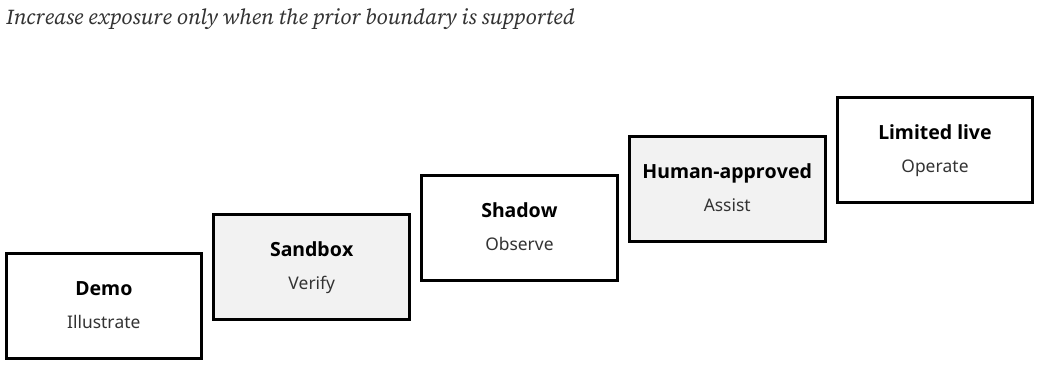
Exposure | Sandbox, then shadow, then human-approved draft if gates pass. | Unobserved live automation or autonomous expansion. |
Time | Six-week pilot with frozen weekly versions and change log. | Indefinite beta or silent model/provider changes. |
- DemoIllustrate
- SandboxVerify
- ShadowObserve
- Human-approvedAssist
- Limited liveOperate
Increase exposure only when the prior boundary is supported
Diagram relationships
- Demo → Sandbox
- Sandbox → Shadow
- Shadow → Human-approved
- Human-approved → Limited live
Define meaningful human control
Authority: the person can reject, edit, defer, escalate, and use the prior workflow.
Information: source request, cited evidence, system uncertainty, and changed fields are visible.
Time and workload: review is possible within real queue conditions and does not become a rubber stamp.
Competence: the person understands the task, common AI failure modes, and when to escalate.
Record: acceptance, edit, override, reason, and resulting state can be audited without punishing appropriate disagreement.
Connect behavior to value
LINK | HARBORLINE HYPOTHESIS | EVIDENCE |
|---|---|---|
Capability | Structure varied requests and retrieve approved evidence. | System evaluation and trace review. |
Task change | Coordinator spends less time interpreting and searching. | Task time and observation. |
Workflow change | More work orders are reviewable on the first pass. | Complete-first-time and rework rate. |
Service outcome | Eligible requests reach scheduling sooner without more safety or contract errors. | End-to-end time, quality, safety, and slices. |
Business result | Capacity or service reliability improves at acceptable full cost. | Volume, staffing, service, cost, and sensitivity analysis. |
Exercise: draw the hard line
A coordinator asks the assistant to assign a technician because the recommended person is obvious. The pilot charter covers drafting only. What should happen?
Worksheet 4: target workflow and boundary
TARGET WORKFLOW AND AI BOUNDARY | |||||||
|---|---|---|---|---|---|---|---|
| |||||||
| |||||||
| |||||||
| |||||||
| |||||||
| |||||||
| |||||||
|
Sources: C1-C5, C13-C18. The consulting sequence, worksheets, and Harborline case are author synthesis. Full citations appear in Further reading.
Make ownership, risk, and permissions explicit
Translate affected people, obligations, and failure paths into controls, gates, and accountable decisions.

Learning objectives. You will map risk to observable controls, assign decision rights and escalation, define data and action permissions, perform vendor diligence, and use standards and law as overlays on the real system rather than as substitute checklists.
Governance is part of delivery
Governance decides who may propose, approve, operate, change, monitor, stop, and retire an AI system. A steering committee alone does not provide those controls. Name who can change the workflow, grant data access, accept vendor terms, approve a release, stop an incident, and represent affected people.
NIST AI RMF FUNCTION | CONSULTING MOVE | EVIDENCE ARTIFACT |
|---|---|---|
Govern | Set policies, roles, risk tolerance, review rights, and accountability across the lifecycle. | Decision-rights map, policy, inventory, review cadence. |
Map | Describe context, affected people, intended use, impacts, dependencies, and risk. | Workflow, system boundary, impact and risk register. |
Measure | Select and run methods for quality, safety, rights, security, reliability, and impact. | Evaluation plan, test evidence, user and workflow measures. |
Manage | Prioritize, treat, accept, transfer, monitor, and respond to risk. | Controls, gates, owners, rollout, incident and retirement plan. |
NIST AI RMF 1.0 is a voluntary risk-management framework. Use its Govern, Map, Measure, and Manage functions to organize evidence, not to certify a deployment. ISO/IEC 42001 provides an organization-level management-system bridge for policy, objectives, risk, performance review, audit, and continual improvement. Neither framework determines the law that applies to a specific engagement.
Write risk as a testable chain
ELEMENT | HARBORLINE EXAMPLE |
|---|---|
Asset or affected interest | Worker and customer safety, correct contract service, personal and commercial data. |
Hazard or failure | A stale manual passage leads to an incorrect urgency cue in a draft. |
Exposure | Coordinator sees the draft during a live queue and may accept it under time pressure. |
Consequence | Wrong service path, delayed safety escalation, bad commitment, or downstream rework. |
Preventive controls | Approved-source inventory, freshness rules, citation, safety phrase routing, excluded priority field. |
Detective controls | Exact source/version trace, sampled expert review, safety slice, override and correction logging. |
Recovery | Stop pilot, revert to current workflow, notify owner, preserve evidence, correct affected records. |
Owner and gate | Service Safety owns consequence; Product owns fix; Risk approves restart after fresh evidence. |
Map permissions from source to effect
LAYER | QUESTIONS | CONTROL |
|---|---|---|
Identity | Which person, role, tenant, and device is acting? | Authenticated identity and role mapping. |
Source data | Which fields and records may this task read? | Least-privilege access, field limits, purpose and retention. |
Model context | What is sent to which provider and under which terms? | Data classification, minimization, approved route, logging limits. |
Output | What may be shown, stored, copied, or used as evidence? | Labeling, provenance, sensitive-output handling, retention. |
Action | Which resource and operation may be proposed or executed? | Server-side authorization, explicit approval, idempotency, audit. |
Change | Who may alter prompt, model, retrieval, tool, policy, or population? | Versioned change control and revalidation. |
Use law as a jurisdictional overlay
As of October 1, 2026, the European Commission reports that the AI Act generally applies from August 2, 2026, with earlier application of prohibited-practice and AI-literacy obligations on February 2, 2025, and general-purpose AI obligations on August 2, 2025. Its current timeline places Annex III high-risk rules on December 2, 2027 and product-integrated Annex I rules on August 2, 2028. Those dates do not classify this pilot. Counsel must check the current legal text, entity roles, use, exceptions, and sector rules before exposure. [C8]
QUESTION | CONSULTING EVIDENCE | REVIEW OWNER |
|---|---|---|
Where and for whom will the system be used? | Locations, users, affected people, entity roles, sector, population. | Legal, privacy, risk, business owner. |
What decisions or rights can it affect? | Workflow, outputs, actions, consequence, human authority, appeal. | Legal, compliance, domain and affected-person representation. |
What data enters, trains, or leaves the system? | Purpose, lawful basis, source, minimization, processors, retention, rights. | Privacy, security, data owner, procurement. |
What classification or duty may apply? | Use-case description, provider/deployer role, transparency, literacy, impact evidence. | Qualified legal and regulatory review. |
How will change be detected? | Version inventory, vendor notice, monitoring, periodic reclassification. | Product owner, risk, vendor manager. |
The OECD's 2026 responsible-AI due-diligence guidance connects adverse impacts to enterprise policies, assessment, prevention, tracking, communication, and remediation. Use supplier questions to identify who will act on a finding, not simply collect assurance documents. This playbook's question bank adapts that approach to an engagement. [C27]
Ask vendors for evidence, not assurance
Exact service, model, region, subprocessors, data flows, retention, training use, deletion, and access controls.
Security and development practices, provenance, vulnerability handling, incident notice, audit evidence, and supply-chain dependencies.
Evaluation methods, limitations, representative and challenge results, monitoring, known failures, and change-notification terms.
Service levels, rate and cost behavior, support, continuity, export, portability, deletion, and exit assistance.
Responsibility for documentation, downstream information, regulatory cooperation, intellectual property claims, and indemnity or liability terms.
Rights to test, audit, suspend, restrict versions, reconcile state, and terminate when evidence or obligations change.
Exercise: assign the decision rights
Harborline's pilot retrieves contract and safety-manual content through a vendor service. Who should be able to approve pilot entry, stop the pilot, accept residual risk, and authorize a new model version?
Worksheet 5: risk, permissions, and governance
RISK, PERMISSIONS, AND GOVERNANCE MAP | |||||||
|---|---|---|---|---|---|---|---|
| |||||||
| |||||||
| |||||||
| |||||||
| |||||||
| |||||||
| |||||||
|
Sources: C1-C15, C18, C20-C22, C25. The consulting sequence, worksheets, and Harborline case are author synthesis. Full citations appear in Further reading.
Design a pilot that can answer a decision
Choose a representative boundary, comparison, measures, exposure limit, and predeclared next-action rule.

Learning objectives. You will distinguish a demonstration from a pilot, write a testable hypothesis, build separate evidence tracks, define a comparison and exposure ladder, and predeclare entry, exit, stop, and next-decision rules.
A pilot exists to reduce named uncertainty
ACTIVITY | PRIMARY JOB | WHAT IT CANNOT ESTABLISH |
|---|---|---|
Concept or storyboard | Make a workflow and experience discussable. | System feasibility or measured value. |
Demonstration | Show a capability on selected examples. | Representative quality, safety, reliability, adoption, or economics. |
Technical prototype | Test an architecture, integration, or hard constraint. | End-to-end workflow impact. |
Usability study | Observe whether people understand and can use a design. | Production performance or business impact by itself. |
Pilot | Test a bounded system and operating model under decision-relevant conditions. | Broad scale, rare-risk absence, or durable value outside its boundary. |
Write a hypothesis with an exposure boundary
The hypothesis names the workflow, population, intervention, comparison, expected outcomes, protected outcomes, exposure, and action that could follow. Avoid 'prove AI works.' A pilot can support a narrower next step or a stop decision.
Keep four evidence tracks separate
TRACK | QUESTION | EXAMPLE MEASURES |
|---|---|---|
Business and service impact | Did the workflow outcome change? | Cycle time, complete-first-time, rework, service-level attainment, full cost. |
System behavior | Did the complete AI system meet its contract? | Field accuracy, citation validity, unsupported claims, reliability, latency, cost. |
Risk and governance | Did controls and ownership operate as intended? | Permission violations, High-severity failures, control coverage, incident response. |
Human and adoption | Could people use, review, challenge, and support the system? | Eligible use, edits, overrides, review time, trust calibration, workload, help. |
Choose a comparison that fits the claim
Before-and-after: practical, but vulnerable to seasonality, staffing, policy, and learning changes.
Concurrent comparison: stronger when eligible units or teams can be allocated fairly and spillover is controlled.
Crossover: useful when teams can use both conditions in a balanced sequence without lasting carryover.
Matched historical baseline: useful when a live comparison is not possible, but matching and missing-data assumptions must be explicit.
Qualitative observation: necessary for workflow fit, comprehension, burden, and unexpected consequences; it complements rather than replaces measures.
Predeclare the decision rules
RULE | HARBORLINE EXAMPLE |
|---|---|
Entry | Approved source inventory, access tests, frozen boundary, trained reviewers, incident path, baseline locked. |
Quality floor | Required fields and citations meet named thresholds overall and in safety and contract slices. |
Hard blockers | Any cross-customer access, invented safety instruction, unauthorized action, or hidden production write stops expansion. |
Workflow outcome | Median active preparation time improves without worse rework, service, or review burden. |
Adoption | Eligible use and review behavior show the system fits the work; non-use reasons are understood. |
Economics | Observed value remains plausible under full recurring cost and sensitivity ranges. |
Next action | Stop, revise, extend, or expand one exposure level; no automatic leap to autonomy. |
Limit exposure deliberately
Constrain users, population, locations, data, actions, volume, duration, versions, and hours. Define the kill switch, degraded workflow, reconciliation steps, communication path, and authority to stop. Exposure should grow one supported boundary at a time.
- DemoIllustrate
- SandboxVerify
- ShadowObserve
- Human-approvedAssist
- Limited liveOperate
Increase exposure only when the prior boundary is supported
Diagram relationships
- Demo → Sandbox
- Sandbox → Shadow
- Shadow → Human-approved
- Human-approved → Limited live
Exercise: reject a weak pilot
A vendor proposes a two-week trial with hand-selected requests, no baseline, and a satisfaction survey. Leaders will decide whether to buy an enterprise license. What is missing?
Worksheet 6: pilot charter
PILOT CHARTER | |||||||
|---|---|---|---|---|---|---|---|
| |||||||
| |||||||
| |||||||
| |||||||
| |||||||
| |||||||
| |||||||
| |||||||
|
Sources: C1-C3, C16-C18, C23, C25. The consulting sequence, worksheets, and Harborline case are author synthesis. Full citations appear in Further reading.
Plan delivery around uncertainty
Coordinate product, data, engineering, evaluation, governance, and adoption through visible decisions and dependencies.

Learning objectives. You will choose build, buy, or partner based on the named constraint; organize workstreams around evidence and decision gates; maintain assumptions and dependencies; and define done as accepted behavior, controls, and evidence rather than completed tasks.
The plan should expose what is not yet known
A conventional project plan can hide AI uncertainty inside a sequence of build tasks. A useful delivery plan pairs every major uncertainty with an experiment, owner, evidence, date, and consequence. Some decisions must be made early because they change data access, architecture, vendor terms, pilot exposure, or the claims the work can support.
WORKSTREAM | CORE QUESTION | DECISION EVIDENCE |
|---|---|---|
Product and workflow | What user outcome and behavior contract are we delivering? | Target workflow, prototypes, usability, acceptance. |
Data and knowledge | Which permitted current sources make the behavior possible? | Inventory, quality sample, access, provenance, freshness. |
Engineering | Can the complete system meet reliability, latency, integration, and recovery needs? | Architecture, prototype, tests, operations plan. |
Evaluation | How will quality, safety, slices, and regressions be measured? | Cases, graders, gates, versioned results. |
Governance and security | Which controls, reviews, records, and decisions are required? | Risk treatment, threat model, approvals, incident path. |
Adoption and operations | Can people use, review, support, and own the workflow? | Role design, training, support, workload, operating owner. |
Commercial | Do terms, full cost, continuity, and exit support the use? | Diligence, contract, cost model, portability test. |
Choose build, buy, or partner from the constraint
PATH | BEST WHEN | WATCH FOR |
|---|---|---|
Buy | The workflow is close to a supported product, speed matters, and vendor controls and terms fit. | Hidden limitations, generic workflow fit, data route, lock-in, weak test rights, changing service. |
Build | The workflow, data, integration, control, or differentiation requires custom behavior. | Underestimated operations, evaluation, security, support, model and tool lifecycle. |
Partner | The client needs specialized delivery or temporary capability while retaining ownership. | Blurred accountability, dependency, IP ambiguity, poor knowledge transfer. |
Hybrid | A vendor model or platform can support a custom governed workflow. | Responsibility gaps across provider, integrator, client, and downstream systems. |
Defer | A prerequisite such as source ownership, baseline, or operating capacity is missing. | Pressure to disguise foundational work as an AI pilot. |
Plan by gates, not phases alone
GATE | QUESTION | MINIMUM PACKET |
|---|---|---|
Discovery lock | Is the problem and decision worth continued work? | Decision brief, current-state evidence, opportunity recommendation. |
Pilot design | Is the boundary testable and governed? | Target workflow, controls, charter, owners, data and vendor path. |
Build entry | Are requirements, sources, architecture, cases, and acceptance ready? | Behavior contract, source inventory, plan, risk and evaluation design. |
Pilot entry | Has the complete candidate passed the bounded readiness review? | System manifest, test results, training, support, stop and recovery rehearsal. |
Exposure change | Does evidence support the next population or action? | Results by track and slice, incidents, residual risk, owner acceptance. |
Handoff | Can the client operate and change the system responsibly? | Accepted runbooks, monitoring, ownership, backlog, vendor and decision history. |
Keep evidence and risk records connected
Give each observation, claim, test, risk, decision, and change a stable ID. Link those IDs across the packet. The evidence record says what was seen; the risk record says what could fail and how it is controlled; the delivery ledgers say what the team decided and changed.
RECORD | WORKED HARBORLINE ROW |
|---|---|
Evidence E-14 | Observed fact: 14/30 requests needed a second lookup. Discovery week; two queues; observation notes O-14; analyst owner. Small convenience sample, not population prevalence. Supports decision D-03 to test retrieval. |
Evidence E-41 | Test result: HSP-0.8 contract citations 89/100 supported the field. Weeks 4-6; review set CT-08; domain reviewers; Product owner. Multiple passages per draft; not independent requests. Below the 95% floor; D-11 holds expansion. |
Risk R-07 | Stale manual may distort a safety cue. Data owns source versions and review dates; stale sources block dependent fields. Verify with stale-source challenges and an update drill. Safety accepts only the tested two-queue exposure; restart requires fresh evidence. |
Maintain three ledgers
Assumption ledger: the belief, evidence, owner, test, due date, and consequence if false.
Decision log: the question, options, evidence, decision maker, date, rationale, dissent, and revisit trigger.
Change record: the requested change, scope and evidence impact, owner, approval, version, and validation needed.
Use a risk-and-dependency log for threats to delivery, but do not hide product, evidence, or governance decisions inside a generic status field. A material unresolved choice needs a decision owner and date.
Define done at the system boundary
Named behavior and outcome contract works on representative and challenge evidence.
Permissions, exclusions, controls, degraded behavior, recovery, and state reconciliation are verified.
Required owners have accepted the evidence for the exact pilot boundary.
Training, support, feedback, incident response, and monitoring are ready for real queue conditions.
Versions, known limitations, residual risks, cost assumptions, and non-claims are documented.
The next decision and the evidence it will use are scheduled before exposure begins.
Exercise: respond to a delivery shortcut
The team can meet the pilot date only by skipping source-access integration and pasting contract text into prompts manually. The pilot aims to measure real workflow time. Should it proceed?
Worksheet 7: integrated delivery plan
INTEGRATED DELIVERY PLAN | |||||||
|---|---|---|---|---|---|---|---|
| |||||||
| |||||||
| |||||||
| |||||||
| |||||||
| |||||||
| |||||||
| |||||||
|
Sources: C3-C5, C13-C16, C20-C22, C27. The consulting sequence, worksheets, and Harborline case are author synthesis. Full citations appear in Further reading.
Build and verify the whole pilot system
Version the complete workflow and require evidence for behavior, controls, recovery, and operations before exposure.

Learning objectives. You will define the complete system under test, build a traceable manifest, connect requirements to verification, distinguish technical checks from owner acceptance, and run a readiness review that can hold or narrow the pilot.
The model is one component
The pilot system includes identity, policy, interface, instructions, context, retrieval, model and provider, tools, validators, permissions, telemetry, human review, support, fallback, and external state. Changing any response-affecting component can weaken prior evidence.
MANIFEST AREA | RECORD |
|---|---|
Workflow | Pilot population, eligibility, task, UI, human role, fallback, and operating hours. |
Application | Code commit, configuration, feature flags, schemas, prompts, routing, tools, time and cost budgets. |
Models and vendors | Provider, service, model snapshot or alias, region, settings, contract and data terms. |
Knowledge and data | Source IDs, owners, versions, access rules, index build, freshness, retention, and lineage. |
Evaluation | Case IDs, set purposes, rubrics, graders, judge versions, thresholds, run settings, and results. |
Controls | Authentication, authorization, validation, approval, logging, rate limits, kill switch, rollback. |
People and process | Reviewers, training version, escalation, support, decision owners, and run date. |
Build a verification matrix
REQUIREMENT | METHOD | EVIDENCE | OWNER |
|---|---|---|---|
No cross-customer source access | Exact authorization and adversarial tests | Request, policy decision, source and denial trace | Security and data |
Draft cites approved current evidence | Representative and stale-source challenge cases | Citation validity, source version, unsupported-claim review | Product and domain |
No autonomous production write | Architecture inspection and runtime state check | Tool list, permissions, audit and resulting state | Engineering and risk |
Coordinator can review meaningfully | Usability, queue simulation, workload observation | Comprehension, edit, override, time and error evidence | Operations and design |
Failure returns to safe workflow | Timeout, provider, retrieval and partial-state rehearsal | Visible status, no hidden commit, recovery and reconciliation | Operations |
Full cost remains bounded | Load and workflow measurement | Tokens, requests, tools, review, support and sensitivity | Product and finance |
Use different methods for different claims
Exact tests for schemas, fields, calculations, permissions, tool calls, external state, and hard invariants.
Representative evaluations for expected workflow cases and meaningful slices.
Challenge and red-team cases for boundary, safety, privacy, injection, misuse, outage, and recovery behavior.
Human evaluation for context-dependent quality and domain judgment, with instructions, independence, disagreement, and adjudication.
Usability and workflow studies for comprehension, review behavior, burden, and error recovery.
Load, resilience, observability, and cost tests for real operating conditions.
For more detail, Michael Long's AI Evaluation Field Guide (Version 1.0.0) covers test sets, human rating, judges, uncertainty, and launch decisions (handbooks.surfaces.systems/ai-evaluation/). His Production AI Engineering (Version 1.4.0) covers the complete runtime, retrieval, tools, monitoring, and failure design (handbooks.surfaces.systems/production-ai-engineering/). Start here by naming the evaluated unit, separating development from decision cases, writing pass and stop rules, having domain reviewers check representative and failure cases, and preserving counts, disagreement, versions, and limitations. A technical owner must verify permissions and resulting state independently of the draft.
Rehearse failure before the pilot
FAILURE | EXPECTED BEHAVIOR | EVIDENCE TO PRESERVE |
|---|---|---|
Source unavailable | Show unavailable state; do not fabricate; return to current lookup path. | Request, source status, fallback, user action. |
Provider timeout | End bounded attempt; retain draft state safely; permit retry or manual path. | Timing, attempt count, user state, retry result. |
Stale or conflicting evidence | Expose sources and conflict; block unsupported field; escalate. | Versions, conflict, block reason, owner. |
Malicious retrieved instruction | Treat source as data; prevent permission or destination change. | Input lineage, policy decision, tool and output trace. |
Partial external write | Stop further action; reconcile authoritative state; notify owner. | Idempotency, request, result, resulting state, reconciliation. |
High-severity finding | Stop affected exposure; preserve evidence; assess affected units; require fresh gate. | Finding, versions, population, containment and restart decision. |
Run an evidence-based readiness review
The system manifest identifies the exact candidate and pilot boundary.
All hard requirements have a method, result, limitation, owner, and evidence link.
High-severity findings are closed, controlled by architecture, or keep the exposure blocked.
Representative, challenge, slice, usability, security, privacy, reliability, recovery, and cost evidence match the decision.
Reviewers, support, monitoring, stop, incident, reconciliation, and communication paths have been rehearsed.
Product, Operations, Engineering, Data, Security, Privacy/Risk, and executive owners accept only the boundary their evidence covers.
Exercise: hold the right boundary
The candidate drafts strong work orders, but the runtime still exposes a production write tool that the prompt says not to use. No test observed a write. Is the pilot ready?
Worksheet 8: readiness evidence packet
READINESS EVIDENCE PACKET | |||||||
|---|---|---|---|---|---|---|---|
| |||||||
| |||||||
| |||||||
| |||||||
| |||||||
| |||||||
| |||||||
|
Sources: C1-C3, C12-C18, C21, C23. The consulting sequence, worksheets, and Harborline case are author synthesis. Full citations appear in Further reading.
Prepare the people who will use and support it
Design the role, review, training, support, and feedback work with the people who will carry it.

Learning objectives. You will map role and task changes, diagnose rational reasons for non-use, design meaningful review and escalation, build role-specific literacy, and measure adoption as observable workflow behavior rather than enthusiasm.
Adoption starts in the target workflow
People adopt a system when it helps them complete accountable work under real conditions. They may reject it because it adds review, hides evidence, threatens role clarity, creates new risk, or performs poorly on the cases that define their expertise. Treat those reasons as product and operating evidence before labeling them resistance.
CHANGE | QUESTION | HARBORLINE EXAMPLE |
|---|---|---|
Task | What is added, removed, accelerated, or made harder? | Less manual drafting; new citation and missing-field review. |
Decision | Who now proposes, reviews, decides, and records rationale? | Assistant proposes; coordinator retains decision and edit authority. |
Knowledge | Which expertise becomes visible, encoded, or newly required? | Coordinators need source and AI-failure literacy; exceptions remain domain work. |
Workload | Where do time, queue pressure, and cognitive burden move? | Preparation may fall while review and feedback initially rise. |
Responsibility | Who is accountable when the system is wrong or unavailable? | Operations owns the work; product and technical owners own system correction. |
Identity and incentives | What status, autonomy, metric, or job concern changes? | Experts may see a drafting tool as devaluing judgment or creating surveillance. |
Support | Who helps, how fast, and with what evidence? | Named supervisor path, issue capture, status visibility, manual fallback. |
Involve affected people at decision points
Discovery: observe the work and validate which problems, exceptions, and outcomes matter.
Boundary: review what the system may do, what stays human, and who could be affected by failure.
Design: test source visibility, correction, override, escalation, and recovery in realistic conditions.
Pilot entry: confirm training, capacity, support, feedback use, and the right to use the fallback path.
Evidence review: include frontline interpretation of usage, burden, workarounds, and unintended effects.
Scale and handoff: agree role design, staffing, operating ownership, continuing literacy, and challenge routes.
Build role-specific AI literacy
Literacy should match the person's role, knowledge, context, and the system's risks. It includes what the system does, where it fails, how to verify evidence, which data and actions are permitted, when to challenge or stop, and how issues are reported. Completion of a generic course is not proof that a person can operate this workflow safely.
ROLE | NEEDS TO KNOW AND PRACTICE |
|---|---|
End user | Purpose, boundary, source review, uncertainty, correction, override, privacy, fallback, issue reporting. |
Supervisor | Queue effects, exception policy, support, review quality, incident escalation, coaching without punishing overrides. |
Product owner | Behavior contract, versions, evidence, change control, adoption, monitoring, release and retirement. |
Technical operator | Architecture, permissions, telemetry, service changes, failure, recovery, reconciliation, cost. |
Risk and control owner | Affected people, obligations, evaluation limits, incidents, residual risk, review triggers. |
Executive decision owner | Value, exposure, evidence quality, hard blockers, total cost, accountability, scale conditions. |
Check access to the workflow
Test source review, edits, override, help, and fallback with people who use keyboards, assistive technology, or alternative ways of perceiving the interface. WCAG 2.2 provides testable web-accessibility criteria; it does not establish that a particular AI workflow is usable or that an employment duty has been met. Include accessibility findings in pilot entry and handoff evidence. [C28]
Design training around work
Use representative and failure cases from the actual boundary, with sensitive details governed appropriately.
Practice accepting a good result, correcting a plausible error, rejecting a dangerous result, escalating uncertainty, and using fallback.
Show how feedback is interpreted and which reports trigger product, data, policy, or support action.
Assess demonstrated behavior, not attendance alone. Retrain when role, model, interface, data, policy, or risk changes materially.
Provide job aids at the decision point: source checks, prohibited actions, escalation reasons, and stop conditions.
Measure adoption without blaming people
MEASURE | WHAT IT CAN SHOW | WHAT TO INVESTIGATE |
|---|---|---|
Eligible use | Whether the system is used when available and applicable. | Availability, speed, fit, training, trust, workload, incentives. |
Completion through workflow | Whether users reach a valid reviewable outcome. | Abandonment, fallback, missing data, confusing states. |
Edit and override | Where proposals differ from accepted work. | Quality, ambiguity, policy, user strategy, over- or under-reliance. |
Review time | The burden of responsible use. | Whether time moved rather than disappeared; queue conditions. |
Feedback and help | Where people need support or encounter novelty. | Severity, responsiveness, psychological safety, duplicate issues. |
Workaround | Where the designed system does not fit. | Whether the workaround protects work or creates new risk. |
Exercise: diagnose low use
Harborline coordinators use the assistant on only 35% of eligible requests. Leaders call them resistant. Observation shows source retrieval often takes 20 seconds, and reviewers must reopen two systems to verify citations. What should happen next?
Worksheet 9: people and adoption plan
PEOPLE AND ADOPTION PLAN | |||||||
|---|---|---|---|---|---|---|---|
| |||||||
| |||||||
| |||||||
| |||||||
| |||||||
| |||||||
| |||||||
|
Sources: C5, C9, C16, C19, C24, C26, C28. The consulting sequence, worksheets, and Harborline case are author synthesis. Full citations appear in Further reading.
Run the pilot as a controlled evidence loop
Use a stable cadence to see what changed, separate causes, control versions, and respond without damaging the evidence.

Learning objectives. You will operate a weekly evidence board, separate system, workflow, policy, data, and adoption causes, control changes, respond to incidents, and preserve enough evidence to make a defensible next decision.
Make the evidence visible while the pilot runs
A pilot is not a period of casual use followed by a survey. The team needs a regular view of exposure, versions, workflow outcomes, system behavior, risk, human behavior, economics, issues, changes, and stop conditions. Review exceptions and slices, not only aggregates.
WEEKLY BOARD | MINIMUM VIEW |
|---|---|
Exposure | Eligible units, attempted units, users, queues, versions, data and action boundary. |
Business/service | Baseline comparison, time, quality, rework, service and important slices. |
System | Contract measures, failures, citations, reliability, latency, cost and regressions. |
Risk/control | Hard blockers, High/Medium/Low findings, permission and control events, residual exposure. |
Human/adoption | Eligible use, completion, edit, override, review time, fallback, help and workaround. |
Issues/incidents | New findings, affected versions and units, containment, owner, status, decision impact. |
Changes | What changed, why, authorization, expected effect, evidence invalidated, validation needed. |
Decision | Continue, narrow, pause, stop, revise, or propose the next exposure. |
Classify the cause before choosing the fix
CAUSE | DIAGNOSTIC QUESTION | EXAMPLE RESPONSE |
|---|---|---|
Workflow | Does the target flow add delay, ambiguity, duplicate work, or a bad handoff? | Redesign the state, review, or integration. |
Policy | Is the expected behavior unclear or disputed? | Resolve policy and update cases, training, and controls. |
Data/knowledge | Is source content missing, stale, inaccessible, conflicting, or poorly indexed? | Fix ownership, access, freshness, retrieval, or provenance. |
Model/context | Does the candidate fail despite correct inputs and contract? | Improve context, prompt, model route, or narrow task. |
Tool/integration | Did a read, write, schema, timeout, or external state fail? | Fix contract, authorization, idempotency, recovery. |
Measurement | Is the case, grader, baseline, or instrumentation misleading? | Repair the measure and rerun fresh evidence. |
Adoption and operations | Are capacity, incentives, training, support, or trust shaping behavior? | Change operating conditions and reassess. |
Control pilot changes
Capture the issue and exact affected system, data, user, and workflow state.
Classify severity and whether the current exposure can continue safely.
Choose the smallest change that addresses the diagnosed cause.
Record every response-affecting version and which prior results remain applicable.
Run targeted regression plus any fresh representative, challenge, usability, or operational evidence required.
Authorize the new candidate and communicate the change to users and owners before resuming exposure.
Frequent improvement is compatible with a controlled pilot, but the evidence must remain attributable. If the system changes every day, report version-specific results and reserve a frozen period for the decision the pilot is meant to support.
Respond to an incident in six moves
MOVE | ACTION |
|---|---|
Contain | Stop or narrow affected exposure; revoke or disable risky capability. |
Preserve | Save prompts, context, sources, tools, policy decisions, traces, external state, versions, and timing. |
Assess | Identify affected people, units, systems, rights, service, data, and obligations. |
Correct | Repair records, notify required parties, reconcile state, and support affected users. |
Learn | Find system and organizational causes; update risk, cases, controls, training, vendor and process. |
Fresh gate | Require fresh evidence and named approval for the exact restart boundary. |
Harborline mid-pilot incident
A stale manual passage leads to a wrong urgency cue in a draft. The coordinator catches it, but trust drops and usage falls. The source record shows the manual owner replaced the PDF without updating the approved index.
Measure the learning system too
Time from finding to triage, containment, owner assignment, fix, validation, communication, and closure.
Repeat findings, reopened issues, stale backlog, unsupported workarounds, and overdue decisions.
Coverage of production findings in regressions, risk controls, training, vendor review, and monitoring.
Whether frontline feedback changes the product or disappears into an unowned channel.
Whether model, source, policy, vendor, workflow, and organizational changes trigger appropriate revalidation.
Exercise: preserve the decision
A team improves the prompt after every bad case and reports one aggregate end-of-pilot score. What is wrong with the claim?
Worksheet 10: pilot evidence board
PILOT EVIDENCE BOARD | |||||||
|---|---|---|---|---|---|---|---|
| |||||||
| |||||||
| |||||||
| |||||||
| |||||||
| |||||||
| |||||||
|
Sources: C1-C3, C12-C18, C23. The consulting sequence, worksheets, and Harborline case are author synthesis. Full citations appear in Further reading.
Turn the evidence into the next decision
Interpret quality, risk, adoption, workflow impact, and economics without rounding mixed evidence up to scale.

Learning objectives. You will synthesize separate evidence tracks, calculate bounded economics, state uncertainty and claim limits, choose stop, revise, extend, or scale, and define the prerequisites for any wider exposure.
Start with the decision, then read every track
TRACK | DECISION QUESTION | DO NOT HIDE |
|---|---|---|
Service impact | Did the end-to-end user or business outcome improve? | Slices, wait and review time, downstream rework, unintended effects. |
System quality | Did the frozen complete system meet the behavior contract? | Counts, uncertainty, grader limits, version and conditions. |
Risk and control | Did hard requirements and controls hold? | High-severity findings, residual risk, incidents, untested paths. |
People and adoption | Could people use, challenge, support, and own the workflow? | Non-use reasons, burden, overreliance, workarounds, job impact. |
Economics | Is the observed outcome plausible at full recurring cost? | Review, support, governance, incidents, integration, variability, exit. |
Operating readiness | Can the organization run and change the system responsibly? | Owners, staffing, monitoring, vendor, recovery, backlog, literacy. |
Use four next-action choices
DECISION | USE WHEN | REQUIRED OUTPUT |
|---|---|---|
Stop | The outcome is weak, a blocker is disproportionate, or prerequisites make the path unattractive. | Reason, preserved learning, obligations, offboarding and affected-state correction. |
Revise | The opportunity remains useful but system, workflow, policy, data, measure, or operating design must change. | Diagnosed cause, new candidate boundary, affected evidence and fresh gate. |
Extend | Evidence is promising but duration, sample, slice, season, or operating condition is insufficient. | Exact uncertainty, additional exposure, controls, measures, stop rule and end date. |
Scale | Every required track and hard gate supports a named wider boundary and ownership is ready. | Population/action increment, operating capacity, monitoring, rollback and next review. |
Build the economics from observed units
Use the pilot unit of work and a range, not a single projected ROI. Start with eligible volume, observed time or outcome change, loaded labor or service value, recurring system cost, human review, support, governance, monitoring, incidents, and change. Keep cash savings, capacity, avoided cost, revenue, quality, and risk reduction distinct.
LINE | PLAIN-LANGUAGE CALCULATION | CAUTION |
|---|---|---|
Gross task capacity | available eligible units x use rate x mean net minutes / 60 | If units already count uses, omit use rate. Use a mean, not a median gap. Observational differences do not prove causal savings. |
Quality effect | change in rework or error units x evidenced consequence | Use credible consequence and include new error classes. |
Service effect | change in throughput, delay, or attainment x evidenced value | Avoid assigning revenue without a causal path. |
Recurring system cost | model + platform + tools + data + infrastructure + vendor | Include variability, peaks, minimums, and provider change. |
Human operating cost | review + support + monitoring + training + governance + incident response | Do not assume human work disappears. |
Change and exit | integration + migration + validation + contract + portability + retirement | Include refresh and switching, not only launch. |
Net range | evidenced benefit range minus full cost range | Run low, expected, and high cases with explicit assumptions. |
Harborline decision snapshot
EVIDENCE | FINDING | IMPLICATION |
|---|---|---|
Workflow | Preparation time and complete-first-time improve in two queues; review remains material. | Assistive workflow has value; capacity conversion needs operating plan. |
System | Overall draft and citation results are promising; contract citations miss their floor and the safety set is small. | Revise retrieval and collect fresh contract and safety evidence before expansion. |
Risk | No unauthorized action observed after tool removal; stale-source incident exposed a governance gap now controlled. | Keep write actions excluded; audit freshness control during expansion. |
Adoption | Later-candidate use is higher; different periods and denominators limit attribution. Supervisors need protected support capacity. | Fund support and monitor review burden. |
Economics | Expected capacity value falls below first-year cost when source cleanup and internal ownership are included. | Tie expansion to eligible volume and review time; avoid booked savings. |
Ownership | Operations, Product, IT, Data and Risk accept the assistive boundary; no owner accepts autonomous dispatch. | Keep the existing assistive boundary; expansion remains conditional. |
Write the claim boundary
For candidate version ___, in population and period ___, compared with ___, the evidence showed ___ across workflow, system, risk, human, and economic tracks. This supports decision ___ within boundary ___. Important uncertainty is ___. It does not establish ___, and wider exposure requires ___.
Exercise: refuse the rounded-up claim
A pilot reduces average preparation time by 30%, but the comparison period had lower volume, review time rose, and one High-severity safety case failed. The sponsor wants to say 'AI increased productivity by 30%.'
Worksheet 11: outcome and decision record
OUTCOME AND DECISION RECORD | |||||||
|---|---|---|---|---|---|---|---|
| |||||||
| |||||||
| |||||||
| |||||||
| |||||||
| |||||||
| |||||||
|
Sources: C1-C5, C16-C19, C23. The consulting sequence, worksheets, and Harborline case are author synthesis. Full citations appear in Further reading.
Leave the client able to continue
Transfer accepted artifacts, decision rights, routines, and capability so the system no longer depends on the consulting team.

Learning objectives. You will define ownership across the system lifecycle, create an accepted handoff manifest and operating runbook, assess capability gaps, plan the first 90 days, and close the engagement without leaving invisible consultant dependency.
Handoff is an operating change
Document delivery is not handoff. The client has to know what exists, why it was designed this way, what evidence supports it, what remains uncertain, who owns each decision, how the system is monitored and changed, and how to stop or retire it. Owners should demonstrate those routines before the consultant leaves.
OWNERSHIP | ACCOUNTABLE WORK |
|---|---|
Business/service | Outcome, workflow policy, service risk, priority, funding, affected-person consequence. |
Product | Behavior contract, roadmap, boundary, evidence, versions, change and next decision. |
Technical | Application, integration, model route, tools, reliability, telemetry, recovery, cost. |
Data/knowledge | Source ownership, permission, quality, provenance, freshness, retention, deletion. |
Security/privacy/risk | Controls, obligations, threat and impact review, residual risk, incidents, audit. |
Operations/support | Users, queue, review, fallback, support, escalation, communication, reconciliation. |
Vendor/commercial | Service and model changes, contract, performance, incident, renewal, portability, exit. |
Executive | Exposure, funding, residual risk, scale or stop, and organizational accountability. |
Transfer the complete record
PACKET | MINIMUM CONTENTS |
|---|---|
Decision history | Briefs, options, evidence, rationales, dissent, scope and change records. |
System | Architecture, manifest, code/configuration locations, data flows, sources, permissions, vendors. |
Evidence | Cases, set purposes, methods, graders, results, limitations, incidents, acceptance and non-claims. |
Operations | Runbook, monitoring, alerts, dashboards, support, incident, rollback, reconciliation, retirement. |
People | Role design, training, job aids, access, review expectations, feedback and escalation. |
Commercial | Contracts, renewals, costs, usage limits, service changes, contacts, export, deletion and exit. |
Future work | Known limitations, risks, technical debt, research questions, backlog, decision dates and owners. |
Use acceptance demonstrations
Product owner identifies the exact production or pilot boundary and explains the next change gate.
Technical operator identifies the running version, traces a request, handles an outage, and executes rollback or degraded mode.
Data owner updates or retires a source, verifies permission and freshness, and explains lineage.
Operations handles a bad result, override, support request, fallback, incident and affected-state reconciliation.
Risk owner locates evidence, understands limitations, reviews residual risk, and knows stop and restart authority.
Vendor owner verifies service-change notice, cost, renewal, audit, export, deletion and exit path.
Executive owner can state the supported value, unresolved risk, full operating commitment, and next decision date.
Build the operating cadence
CADENCE | REVIEW |
|---|---|
Continuous | Availability, errors, security, permission, cost, hard stop and incident signals. |
Weekly | Workflow outcomes, quality samples, adoption, support, changes, issues, slices and owner actions. |
Monthly | Trend, drift, full cost, vendor behavior, training, backlog, risk and control performance. |
Quarterly or risk-based | Boundary, value, affected people, reclassification, external obligations, roadmap and retirement. |
Event-triggered | Model/provider change, source change, incident, policy or law change, new population, data, action or location. |
Plan the first 90 days
PERIOD | FOCUS |
|---|---|
Days 0-30 | Shadow the operating owners; close access and documentation gaps; run incident, rollback, source-update, and vendor-change drills. |
Days 31-60 | Client owners lead weekly evidence review and one controlled change; consultant observes only where agreed. |
Days 61-90 | Client runs review, change, revalidation, and executive decision cadence; resolve remaining capability gaps or narrow exposure. |
Exit | Named owners sign acceptance; consultant access, accounts, data, tools, and support obligations are closed or transferred. |
Retirement is part of ownership
Define triggers: weak value, unsupported provider, control failure, new obligation, excessive cost, replaced workflow, or owner loss.
Stop new use, preserve required evidence, reconcile external state, communicate, revoke access, export or delete data, and end vendor services.
Retain the decisions, incidents, measures, and lessons needed for audit and future systems under the applicable policy.
Verify that affected people have a working replacement or fallback and know how to challenge lingering outcomes.
Exercise: refuse a paper handoff
The final packet is complete, but the product owner has never run the evidence review, the data owner cannot update the source index, and the incident drill still depends on the consultant. Can the engagement close?
Worksheet 12: handoff and closeout
HANDOFF AND CLOSEOUT RECORD | ||||||||
|---|---|---|---|---|---|---|---|---|
| ||||||||
| ||||||||
| ||||||||
| ||||||||
| ||||||||
| ||||||||
| ||||||||
|
Sources: C1-C5, C12-C14, C16, C18-C22, C24. The consulting sequence, worksheets, and Harborline case are author synthesis. Full citations appear in Further reading.
Guided capstone: Harborline decision review
Use the fictional evidence packet to make a bounded consulting recommendation and handoff plan. Allow two to three hours. The packet contains enough information to make a defensible decision, but some evidence is intentionally incomplete or in tension.
1. Sponsor memo
Harborline maintains commercial refrigeration and food-service equipment across four regions. Peak season begins in twelve weeks. The COO believes AI dispatch could reduce response time and wants an enterprise recommendation. The VP of Service wants fewer incomplete work orders. The CIO wants one approved platform. The Safety Director will not accept automation that changes urgency, assigns a technician, or communicates a commitment without accountable review. Coordinators remember a prior trial that produced fluent but unsupported answers.
STAKEHOLDER | DESIRED OUTCOME | CONCERN | DECISION AUTHORITY |
|---|---|---|---|
COO | Capacity and faster service before peak. | Slow transformation and fragmented tools. | Funds exposure and accepts enterprise risk. |
VP Service | Complete work orders and predictable queues. | Review burden and disruption. | Owns workflow and service outcome. |
CIO | Supported architecture and vendor model. | Security, integration, cost, lock-in. | Approves technical operating model. |
Safety Director | Correct escalation and protected work. | Stale evidence, automation bias, hidden decisions. | Owns safety policy and stop/restart for safety exposure. |
Coordinators | Less searching and duplicate entry. | Bad drafts, surveillance, loss of judgment, extra review. | Perform and accept the daily workflow. |
2. Current-state evidence
MEASURE | BASELINE | IMPORTANT NOTE |
|---|---|---|
Eligible service requests | About 2,400 per month across four regions | Volume varies 35% by season; pilot queues represent 38% of current volume. |
Median active preparation | 12.4 minutes | Includes intake, lookup, clarification, and work-order drafting. |
Median elapsed to reviewable order | 46 minutes | Waiting for customer or supervisor drives the tail. |
Complete on first review | 61% | Serial number, contract, and safety fields cause most rework. |
Safety escalation | 3.8% of requests | Rare but consequential; policy language varies by equipment. |
Contract exception | 11% of requests | Sources span two systems; 7 of 100 contracts sampled during discovery have inconsistent labels. |
Coordinator systems | Five commonly used | Two lack single sign-on; source switching is a major burden. |
Observations of 30 requests found that coordinators often start the work order before all evidence is available, then reopen it after checking manuals and contracts. Fourteen needed a second source lookup. Eight used a personal note or saved link. Supervisors described urgent safety cases as the point where expert judgment and phone escalation matter most.
3. Opportunity choices
OPPORTUNITY | EVIDENCE | MAIN DEPENDENCY OR RISK |
|---|---|---|
Structured intake | Missing fields and inconsistent language drive rework. | Channel integration and field policy. |
Approved evidence retrieval | Search and source switching add time; staff need attributable answers. | Access, ownership, source freshness, contract label cleanup. |
Work-order drafting | Rewriting consumes time and follows a repeatable structure. | Unsupported facts, review design, measurement. |
Priority recommendation | Leaders expect queue benefit; no clean historical ground truth. | Safety, policy disagreement, bias, meaningful oversight. |
Technician assignment | Potential scheduling benefit is not baselined. | Certification, geography, availability, union rules, permissions, writes. |
Customer communication | May reduce callbacks. | Commitments, tone, consent, contract and state reconciliation. |
4. Data, architecture, and vendor packet
ITEM | FINDING |
|---|---|
Requests | Contain customer contact, account, location, equipment, symptom, free text, attachments, and sometimes sensitive information. |
Manuals | Approved central library exists; 9 of 100 manuals sampled during discovery lack a recorded owner or review date. |
Contracts | Access is role-based, but labels and effective dates differ across systems. |
Prior work orders | Useful for language and troubleshooting context; retention and cross-customer reuse require review. |
Vendor service | Hosted model and retrieval platform; regional processing available; contract bars training on client content but change notice is only 14 days. |
Vendor evaluation | High aggregate extraction score on 100 vendor-created cases; no Harborline safety or contract slice and no independent grader report. |
Tools | Prototype exposes request read, source search, draft save, priority update, assignment, and outbound message tools. |
Operations | Vendor provides uptime target; Harborline must own source freshness, user access, evaluation, monitoring, incident triage, and state reconciliation. |
5. Proposed six-week pilot
DESIGN | PROPOSED CHOICE |
|---|---|
Population | Two queues, weekdays, named coordinators, eligible intake and work-order tasks. |
Intervention | Structure request, retrieve approved sources, list missing information, draft work order. |
Comparison | Concurrent eligible requests handled with the current workflow, assigned by shift and queue where practical. |
Exposure | Week 1 sandbox; week 2 shadow; weeks 3-6 human-approved drafts if entry gates pass. |
Excluded | Priority, technician assignment, customer commitments, outbound messages, autonomous writes. |
Primary workflow measures | Active preparation time, elapsed time, complete-first-review, rework, service-level attainment. |
Protected outcomes | Safety and contract errors, cross-customer access, unsupported claims, review burden, incidents. |
Stop rules | Unauthorized data/action, invented safety instruction, hidden write, repeated stale-source failure, uncontained incident. |
6. Frozen candidate results
All numbers in this packet are invented for practice. Weeks 1-3 used HSP-0.7 for sandbox, shadow, and early assisted work. Its 29 incident-exposed drafts are reported separately below. After a fresh gate, HSP-0.8 froze the model, prompts, source index, freshness checks, permissions, and review interface for weeks 4-6. That cohort contains 612 eligible requests: 318 completed with assistance and 294 in the current workflow. Twelve coordinators participated. Assistance was available on 442 requests; 318 used it and 124 chose fallback. Those 124 are included in the 294 current-workflow requests alongside 170 requests without assistant access. This comparison therefore includes self-selection as well as nonrandom shifts.
TRACK | RESULT | LIMIT |
|---|---|---|
Preparation time | Median 8.6 minutes assisted vs 12.1 comparison. | Queues were concurrent, but shift assignment was not randomized. |
Elapsed to reviewable | Median 35 vs 44 minutes. | Customer waiting remains highly variable. |
Complete first review | 242/318 = 76.1% vs 185/294 = 62.9%. | Improvement smaller on contract-exception slice. |
All required fields correct | 298/318 submitted HSP-0.8 drafts = 93.7%. | Every assisted draft was audited; this is a draft-level measure, not field accuracy. |
Citation validity | 546/565 cited passages supported the field = 96.6%. | Contract: 89/100; routine manual: 392/400; other: 65/65. Passages cluster within drafts. |
Unsupported safety claim | 0 in 74 safety challenge cases after fix. | Small challenge set; does not establish zero production risk. |
Cross-customer access | 0 observed; exact authorization suite 180/180 passed. | Only configured pilot identities and sources were tested. |
Review time | Median 2.9 minutes; 57/318 = 17.9% required substantive edits. | Review burden is included in preparation measure. |
Eligible use | 318/442 = 71.9%; final two weeks 168/200 = 84%. | The final 200 available requests are a subset of the 442. Fallback remains permitted. |
Platform cost | $8.10-$13.60 platform cost per 100 available eligible units. | Add internal ownership, source cleanup, and any enterprise tier using the worked model below. |
Declared gates and missing outcomes
PREDECLARED EXPANSION GATE | HSP-0.8 EVIDENCE | DECISION |
|---|---|---|
All-fields-correct drafts at least 93% | 298/318 = 93.7% | Point estimate passes; review uncertainty. |
Valid citations at least 95% overall AND in contract slice | 546/565 = 96.6%; contract 89/100 = 89% | Contract floor fails. Hold expansion. |
No unauthorized data/action or invented safety instruction | No event observed in 318 submitted units; 180/180 authorization tests; 0/74 safety challenges | Supports tested controls, not absence of rare risk. |
Rework no worse; service and safety/contract outcomes measured | Rework 76/318 vs 109/294; service-level attainment and downstream contract-error audit incomplete | Outcome evidence incomplete. Hold expansion. |
Owners ready; full cost acceptable | Deletion evidence and provider-change drill open; first-year expected net capacity value negative | Hold expansion; decide whether bounded repair is worth funding. |
A passing point estimate is not a guarantee. The 74 safety challenges are selected stress cases, not a production prevalence sample. Keep the zero count and its selection limits together.
7. Mid-pilot incident and response
A stale compressor manual passage produced a wrong urgency cue in one draft. The coordinator caught it before submission. Investigation found that the document owner replaced the PDF without updating the approved index or review date. The team paused that equipment class, searched affected units, corrected the index, added owner and freshness gates, displayed source status in review, created regressions, and required Safety, Data, Product, and Risk approval before resuming. No submitted work order contained the wrong cue.
EFFECT | EVIDENCE |
|---|---|
Containment | Affected class paused in 18 minutes; all 29 HSP-0.7 drafts reviewed; 28 had correct required fields, one had the caught wrong urgency cue, and none committed it. |
Eligible use | Early HSP-0.7 use fell from 71% to 49% after the incident. The later HSP-0.8 cohort ended at 168/200 = 84%; different periods and denominators prevent treating this as a controlled effect of the fix. |
Control | Source owner and review date now required; stale status blocks draft fields that depend on the source. |
Residual risk | Other manual classes were sampled, not exhaustively verified; source governance remains an operating dependency. |
8. Ownership and capability
AREA | CURRENT STATE |
|---|---|
Service Operations | Owns review policy; current support uses 16 hours/month. Expansion would require 0.3 FTE, assumed 48 hours/month. |
Product | Named owner accepts behavior contract, evidence board, version and change process. |
IT/Engineering | Can operate integration and rollback; provider-change rehearsal remains incomplete. |
Data | Owners assigned for pilot sources; enterprise source inventory is incomplete. |
Safety/Risk | Accepts only current two-queue exposure during approved repair; expansion awaits contract and outcome evidence. |
Vendor | Will add 30-day model-change notice at enterprise tier; export test passed; deletion evidence pending. |
Economics | Expected first-year net capacity value is negative in the worked model; wider support requirements worsen it. |
9. Reproduce the monthly economics
For practice, assume a month has 912 available eligible requests in the two queues (2,400 x 38%). Use 72% as the planning use rate, not as a replacement for 318/442 in the cohort report. Observed HSP-0.8 group mean preparation times are 8.8 and 11.8 minutes, including review, a 3.0-minute association. Nonrandom allocation prevents a causal savings claim. The median gap of 3.5 minutes is not used to calculate total capacity.
Loaded labor value is an assumed $45/hour. Current supervision is 16 hours/month plus 8 hours for data, product, monitoring, and risk, at the same rate: $1,080/month. Source cleanup costs $6,000 once; spreading it over the first twelve months adds $500/month. Expected platform cost uses $10.85 per 100 available requests. No staffing reduction, added billable work, or cash saving has been demonstrated.
SCENARIO | AVAILABLE; USE; MINUTES | CAPACITY VALUE | NET/MONTH, YEAR 1 |
|---|---|---|---|
Low | 400; 50%; 2 | $300.00 | $300 - $54.40 - $1,080 - $500 = -$1,334.40 |
Expected | 912; 72%; 3 | $1,477.44 | $1,477.44 - $98.95 - $1,080 - $500 = -$201.51 |
High | 1,400; 84%; 4 | $3,528.00 | $3,528 - $113.40 - $1,080 - $500 = $1,834.60 |
Capacity value = available requests x use rate x mean net minutes / 60 x $45. Scenario assumptions are not additional observed pilot results. With one comparable 456-request queue added, expected capacity value is $2,216.16/month, but 48 supervisor hours plus 8 ownership hours cost $2,520 before platform, cleanup, or enterprise support. Wider volume does not automatically solve the economics. Ask Finance to value service improvements separately and avoid double-counting them as time and revenue.
Capstone tasks
Rewrite the executive request as the decision the packet can support.
Choose stop, revise, extend, or scale and name the exact next boundary.
Identify the decisive evidence, hard blockers, measurement limits, and residual risks.
Explain why the recommendation does or does not include priority, assignment, customer communication, or autonomous writes.
Write the next gate: prerequisites, owners, evidence, stop rules, and date.
Create a handoff plan covering Operations, Product, IT, Data, Safety/Risk, Vendor, and executive ownership.
State the supported claim and at least five non-claims.
Guided capstone decision worksheet
GUIDED CAPSTONE DECISION WORKSHEET | |||||||
|---|---|---|---|---|---|---|---|
| |||||||
| |||||||
| |||||||
| |||||||
| |||||||
| |||||||
|
Guided capstone answer key
The packet supports more than one carefully bounded implementation detail, but it does not support enterprise automation. A strong answer preserves the distinction between an assistive workflow and dispatch decisions or actions.
1. Reframe the decision
2. Read the evidence by track
Workflow: preparation, elapsed time, and complete-first-review improved in the two pilot queues. Concurrent comparison helps, but nonrandom shifts and seasonal variation limit causal certainty.
System: the draft-level point estimate passes, but contract citations are 89/100 against a 95% floor. Repair retrieval and review, then test fresh cases. Service-level and downstream contract-error evidence is missing.
Risk: the reduced runtime tool set and exact authorization suite support the assistive boundary. They do not support any excluded action. The stale-source incident shows that knowledge governance is a material operating control.
People: later-candidate use was higher, but different periods and denominators prevent attributing that change to the repairs alone. Support capacity and review burden belong in the operating model.
Economics: the expected first-year capacity-value case is -$201.51/month before an enterprise tier. It is not cash savings. Expansion needs more supervisor support. A positive high case does not close the funding decision.
Ownership: acceptance is limited to current two-queue exposure during approved repair. Deletion evidence and a provider-change drill remain open. No owner accepts automated priority or assignment.
3. Make the bounded recommendation
Within ten working days of this review, Product brings the repair plan, Finance brings the cost sensitivity, and Risk brings the open controls to the COO. No reply means no new exposure. If approved, run four weeks on one frozen repaired candidate in the same queues, review weekly, and decide again on the next working day after week four. Contract citations must pass the declared floor on fresh cases; missing outcomes must be measured. Safety, Privacy, Security, and Operations retain immediate stop authority.
4. Keep excluded actions blocked
ACTION | WHY THE PACKET DOES NOT SUPPORT IT |
|---|---|
Priority recommendation | No reliable baseline or agreed ground truth; safety consequence and policy variation remain material. |
Technician assignment | Certification, geography, labor rules, availability, authorization, state, and recovery were not evaluated. |
Customer communication | Commitment, consent, contract, tone, channel, approval, and reconciliation were outside the pilot. |
Autonomous write | The successful boundary depends on the action being unavailable and on coordinator approval through the existing system. |
Enterprise rollout | Other regions, sources, users, volume, season, support, contracts, and governance were not represented. |
This gate repairs the existing boundary. It does not admit an additional queue.
5. Define the next gate
Complete vendor deletion evidence and provider-change rehearsal.
Assign and audit source owners, review dates, access, and freshness for the repaired candidate in the current two queues.
Protect supervisor support capacity and train users on sources, review, override, fallback, and incident reporting.
Freeze the candidate and predeclare larger contract and safety slices plus service, review, adoption, cost, and control measures.
Retain the same hard stop conditions, response path, reduced tool set, and manual workflow.
Require Service Operations, Product, IT, Data, Safety/Risk, Vendor owner, and executive owner to accept only the current two-queue repair boundary. Review a separate expansion proposal after the repair gate.
Handoff plan for the current boundary
OWNER | ARTIFACT AND ACCEPTANCE DEMONSTRATION | DUE |
|---|---|---|
Operations | Review policy, fallback, incident runbook; supervisor runs a bad-draft and outage drill. | Before repair exposure |
Product | Candidate manifest, cases, decisions; leads weekly evidence review and one controlled change. | Before final review |
IT | Runtime, permissions, rollback; rehearses provider change and restores prior version. | Before repair exposure |
Data | Source inventory and freshness rules; updates a manual and verifies index, access, and denial. | Before repair exposure |
Safety/Risk | Residual risks and stop/restart record; reviews safety and contract evidence and witnesses incident drill. | At every exposure gate |
Vendor | Change, export, retention, deletion terms; supplies deletion evidence and tests exit. | Before repair exposure |
COO / Finance | Full cost, service value, funding, claim limits; accepts only the demonstrated boundary. | Ten-day decision and week-four review |
Meet weekly during repair. After accepted handoff, use the Chapter 12 continuous, weekly, monthly, and event-triggered cadence. Keep consultant access and support obligations explicit until each owner demonstrates the transferred task. Missing demonstrations keep handoff open even when the files are delivered.
6. State the non-claims
The pilot does not establish that AI can automate dispatch.
The pilot does not establish zero safety, privacy, access, or unsupported-claim risk.
The pilot does not establish the same effect in other regions, seasons, equipment classes, contracts, or user groups.
The pilot does not establish causal productivity improvement or cash savings.
The pilot does not establish readiness for priority, assignment, communication, or autonomous writes.
The pilot does not establish legal compliance for every jurisdiction or use.
The pilot does not establish that future model, vendor, source, policy, workflow, or staffing changes remain covered by the evidence.
Guided capstone self-assessment
Rate each category. Competence requires a defensible boundary in every category; a strong average cannot compensate for a missing safety, permission, evidence, or ownership decision.
LEVEL | DESCRIPTION |
|---|---|
Absent | The decision, evidence, owner, control, or claim boundary is missing. |
Developing | The right topic appears, but important distinctions, evidence, controls, or owners are vague or wrong. |
Competent | The recommendation uses the correct evidence, preserves boundaries, and names practical owners and next gates. |
Strong | The answer also challenges assumptions, anticipates failure and operating change, and designs proportionate disconfirming evidence. |
CATEGORY | COMPETENT EVIDENCE |
|---|---|
Decision frame | Names the owner, choices, workflow, population, date, evidence, and non-goals. |
Current work | Uses observed facts, baseline, exceptions, affected people, and limitations. |
Opportunity | Compares alternatives and classifies assist, recommend, decide, or act. |
Boundary | Names permitted data, outputs, actions, exposure, human authority, and fallback. |
Governance | Connects risk to controls, permissions, legal review, vendors, decision rights, and stop/restart. |
Pilot | Uses comparison, separate evidence tracks, gates, slices, stop rules, and version control. |
Delivery | Coordinates product, data, engineering, evaluation, governance, adoption, commercial, and operations. |
Evidence | Interprets workflow, system, risk, people, economics, and ownership without averaging blockers away. |
Decision | Chooses stop, revise, extend, or one supported scale boundary with prerequisites. |
Handoff | Transfers accepted artifacts, owners, runbooks, cadence, capability, vendor and retirement paths. |
Automatic non-passing misconceptions
Treating executive sponsorship or a workshop score as proof of value.
Recommending autonomous dispatch without safety, authorization, state, recovery, and ownership evidence.
Claiming ROI without a baseline, comparison, full operating cost, sensitivity, and conversion mechanism.
Averaging away a High-severity failure or using adoption to offset a control gap.
Calling low use resistance without examining latency, review burden, workflow fit, incentives, and trust.
Calling handoff complete without named owners, acceptance demonstrations, monitoring, rollback, vendor, and retirement paths.
Appendix A: consulting lifecycle
Use this as the front sheet for an engagement or review packet.
DECISION - A named owner, choices, evidence standard, date, scope, non-goals, and integrity disclosures are visible.
WORK - The unit, actors, evidence, decisions, tools, queues, exceptions, baseline, and affected people are observed.
OPPORTUNITY - Process, rules, information, AI, and defer options are compared; unknown is not scored as neutral.
BOUNDARY - Users, data, outputs, actions, exposure, time, human authority, fallback, and non-claims are explicit.
GOVERNANCE - Risk chains, controls, permissions, legal review, vendor evidence, decision rights, stop and restart are owned.
PILOT - Hypothesis, population, comparison, separate evidence tracks, gates, hard blockers, exposure, and versions are predeclared.
DELIVERY - Product, data, engineering, evaluation, governance, adoption, operations, and commercial decisions are integrated.
READINESS - The exact complete candidate has representative, challenge, control, recovery, usability, cost, and owner evidence.
PEOPLE - Role and workload change, meaningful review, literacy, training, support, feedback, and non-use reasons are addressed.
OPERATE - Weekly evidence, slices, issues, incidents, changes, state reconciliation, communication, and stop rules are active.
DECIDE - Service, system, risk, people, economics, and ownership are interpreted separately; the next boundary is exact.
TRANSFER - Accepted artifacts, owners, runbooks, cadence, capability, vendor, retirement, and consultant closeout are verified.
CLAIM - The final sentence states what the evidence supports, the uncertainty, and what it does not establish.
Appendix B: discovery interview and observation guide
Sponsor and decision owner
What decision must be made, by whom, and by what date?
Which outcomes matter, how are they measured now, and what tradeoff is unacceptable?
What answer do you currently expect, and what evidence could change your mind?
Which people, rights, safety, service, data, contracts, and jurisdictions can be affected?
What is explicitly outside this engagement, and who may change that boundary?
People who perform and receive the work
Walk me through the last real unit from arrival to outcome. Where did you wait, switch, check, ask, or recover?
Which cases are easy, ambiguous, rare, high consequence, or impossible?
What evidence do you trust, where does it come from, and how do you know it is current?
What would a proposed assistant need to show so you could review it responsibly?
Which errors create rework, embarrassment, harm, rights impact, or hidden downstream cost?
What would make you avoid the system even if leaders wanted it used?
Observation prompts
Start and end state; unit of work; eligibility and slice.
Actors, evidence, decisions, tools, copies, searches, handoffs, queues, waits, interruptions.
Normal path, exceptions, workarounds, escalation, fallback, recovery, and downstream correction.
Active time, elapsed time, review, rework, error, outcome, user and employee burden.
What the systems record, what they omit, and which personal artifacts fill the gap.
Fact, participant report, interpretation, proposal, and unresolved question recorded separately.
Appendix C: assist, recommend, decide, and act
PATTERN | GOOD FIRST USES | REQUIRED QUESTIONS | EXPANSION GATE |
|---|---|---|---|
Assist | Drafting, transformation, retrieval, summarization, classification support. | Can a person verify? Are sources and uncertainty visible? Is fallback easy? | Representative quality, review burden, safe data, support and workflow value. |
Recommend | Ranking, triage, suggestions, options, risk flags. | Is the decision policy agreed? Can the person challenge? Are slices and overrides understood? | Validated decision support, meaningful oversight, protected outcomes, audit and appeal. |
Decide | Bounded low-consequence decisions with observable rules and appeal. | What rights, safety, money, access or service changes? Who is accountable? | Legal and risk review, strong evidence, control architecture, challenge and remediation. |
Act | Reversible, narrow, authorized actions with exact confirmation and recovery. | Which resource, permission, side effect, external state, duplicate and rollback path? | Server authorization, idempotency, approval, state checks, incident, reconciliation and owner acceptance. |
Appendix D: measurement and economics cheat sheet
MEASURE | PLAIN-LANGUAGE CALCULATION | COMMON MISTAKE |
|---|---|---|
Eligibility | eligible units / all arriving units | Reporting usage against cases the system cannot handle. |
Eligible use | used eligible units / eligible units available | Calling non-use resistance without investigating conditions. |
First-pass acceptance | units accepted without rework / completed units | Ignoring downstream correction or weak review. |
Active time | time spent doing the task and review | Calling reduced model or transaction time a workflow gain. |
Elapsed time | end timestamp minus start timestamp | Ignoring queues, waits, scheduling, and customer response. |
System pass rate | passing evaluated units / evaluated units | Hiding set purpose, slices, grader, uncertainty, and version. |
Override/edit | overridden or materially edited units / reviewed units | Treating every edit as a model failure or every acceptance as correctness. |
Incident rate | incidents / defined exposure unit | Comparing unlike severity, detection, population, or time windows. |
Gross capacity | available eligible units x use rate x mean net minutes / 60 | If volume already counts uses, do not multiply by use rate again. A median gap cannot total capacity; cash needs a conversion plan. |
Full recurring cost | system + data + human review + support + governance + monitoring + incidents | Using provider token cost as total cost. |
Net value range | credible benefit range minus full cost range | Using one optimistic point estimate and excluding change or exit. |
Appendix E: governance and vendor question bank
AREA | QUESTIONS |
|---|---|
System role | What is the intended and prohibited use? Who is provider, deployer, operator, affected person, and decision owner? |
Data | What enters, leaves, persists, trains, logs, crosses regions, reaches subprocessors, or supports rights requests? |
Models | Which service and version run? How are changes announced, constrained, tested, rolled back, and audited? |
Security | How are identity, authorization, isolation, secrets, source-to-sink policy, vulnerabilities, incidents, and supply chain handled? |
Evidence | Which representative, challenge, slice, security, human, reliability, cost, and monitoring evidence exists? Who produced and graded it? |
Human oversight | What can the person see, decide, override, appeal, stop, and recover under real workload? |
Operations | Who monitors, supports, triages, changes, reconciles, communicates, and retires the system? |
Commercial | What are full price, minimums, limits, SLAs, support, audit rights, liability, renewals, portability, deletion, and exit? |
Regulatory | Which jurisdictions, sectors, classifications, documentation, transparency, literacy, impact, and incident duties require qualified review? |
This question bank supports diligence and issue spotting. It is not a complete security, privacy, procurement, employment, accessibility, sector, or legal review. Tailor it to the actual use and accountable reviewers.
Appendix F: plain-language glossary
TERM | MEANING IN THIS PLAYBOOK |
|---|---|
Slice | A meaningful subset of cases, such as contract exceptions or safety-related requests. Report its own count and result. |
Grader | The person or rule that evaluates a result. Check the grader against a defensible human reference before using its score. |
Ground truth | A reference answer established by a stated process, not an infallible label. Preserve expert disagreement. |
Lineage | The trace from a draft field back to the request, source, version, and transformation that produced it. |
Idempotency | Repeating the same authorized operation does not repeat its side effect. A retry must not create a second work order. |
Reconciliation | Check the authoritative system after an uncertain operation and repair any mismatch before acting again. |
Source-to-sink policy | Rules for where information may come from and where it may go. A customer's contract cannot enter another customer's draft. |
AI system | Model plus application, instructions, data, retrieval, tools, interface, permissions, people, policies, monitoring, and external state. |
AI boundary | The users, workflow, data, outputs, actions, exposure, time, and exclusions that define permitted use. |
Behavior contract | Observable intended behavior, hard failures, fallback, and claims for the named system and use. |
Decision owner | The person accountable for accepting an action and its residual risk; contributors may supply evidence without owning the decision. |
Evidence ledger | Traceable record of claims, sources, observations, tests, results, limitations, versions, and decisions. |
Exposure | Who and what can be affected: users, units, data, actions, volume, time, location, and consequence. |
Hard blocker | A predeclared condition that prevents entry or expansion regardless of aggregate performance. |
Human oversight | A designed ability to understand, challenge, decide, stop, and recover; not merely the presence of a person. |
Pilot | A bounded test of a system and operating model under conditions chosen to support a named decision. |
Representative evidence | Evidence sampled to estimate behavior for a named deployment population under stated assumptions. |
Challenge evidence | Risk-enriched cases intended to expose boundaries, rare failures, attacks, outages, and severe conditions. |
Residual risk | Risk remaining after treatment, considered by an accountable owner within a named boundary. |
System manifest | Versioned identity of the workflow, application, model, data, evaluation, controls, people, and vendors under test. |
Meaningful human control | Authority, information, time, competence, record, and fallback sufficient for real responsibility. |
Adoption | Observable use and completion behavior within eligible work, interpreted with fit, burden, incentives, trust, and support. |
Drift | Change in users, work, data, policy, model, vendor, environment, measurement, or outcomes that can weaken prior evidence. |
Scale | A specific expansion of population, volume, data, location, action, autonomy, or duration, each requiring matched evidence. |
Handoff | Accepted transfer of artifacts, access, decision rights, runbooks, capability, vendor management, cadence, and accountability. |
Claim boundary | A statement of what the evidence supports and what it does not establish. |
Appendix G: worksheet index
Print the worksheets or copy their fields into the client's governed document system.
WORKSHEET | MODULE | PURPOSE |
|---|---|---|
Engagement decision brief | 1 | Name the decision, owner, scope, evidence, non-goals, date, and integrity boundary. |
Current-state evidence | 2 | Map the real work, baseline, exceptions, evidence, facts, and unresolved questions. |
Opportunity recommendation | 3 | Compare alternatives and select one bounded change worth testing. |
Target workflow and boundary | 4 | Define future flow, behavior contract, permissions, exclusions, fallback, and value hypothesis. |
Risk, permissions, governance | 5 | Connect affected people and failures to controls, ownership, legal review, and vendor evidence. |
Pilot charter | 6 | Predeclare hypothesis, population, comparison, measures, gates, exposure, and next action. |
Integrated delivery plan | 7 | Coordinate workstreams, gates, decisions, assumptions, dependencies, and definition of done. |
Readiness evidence packet | 8 | Identify the complete candidate and collect behavior, control, recovery, and acceptance evidence. |
People and adoption plan | 9 | Design role change, literacy, review, training, support, feedback, and adoption measures. |
Pilot evidence board | 10 | Operate a versioned weekly learning, issue, incident, change, and exposure decision loop. |
Outcome and decision record | 11 | Synthesize separate tracks into stop, revise, extend, or bounded scale. |
Handoff and closeout | 12 | Transfer accepted ownership, artifacts, runbooks, cadence, capability, vendor, and exit. |
Capstone decision | Capstone | Make and defend the complete Harborline recommendation and proof boundary. |
Further reading and source notes
The playbook favors governing texts, standards bodies, regulators, official public-sector guidance, and direct technical documentation. Source status matters: law changes; living pages and vendor documentation can change; NIST frameworks are voluntary; OECD recommendations are non-binding; ISO summaries do not replace the paid normative text; a useful procurement pattern can outlast its legal references. Refresh fast-moving sources before publication or a client decision.
SOURCE GROUP | HOW IT IS USED | STATUS CAUTION |
|---|---|---|
C1-C3 | Risk-management backbone and operational actions. | Voluntary frameworks; select actions for the actual use and evidence. |
C4-C5 | Management system and trustworthy-AI principles. | ISO full requirements are paid; OECD recommendation is non-binding. |
C6-C11 | EU AI Act, 2026 amendment, implementation, literacy, privacy. | C8 supports the attributed timeline. C6-C7 legal bodies and C9 FAQ were unavailable to this check; review current law. |
C12-C15, C21 | Cyber, secure development, AI threats, supplier diligence. | Adapt to sector, architecture, provider and current threat model. |
C16-C19, C24-C26 | Problem framing, impact, accountability, adoption, literacy, worker considerations. | Public-sector context needs localization; adoption data may lag. C24 and C26 bodies were unavailable. |
C20, C22 | Contract and procurement diligence patterns. | Older or pre-2026 legal references require updating. |
C23 | Evaluation design principles. | Living platform documentation; product details and deprecation timelines can change. |
C27-C28 | Responsible AI diligence and accessible web workflows. | Voluntary diligence and testable web criteria; neither establishes every legal duty. |
[C1] NIST. Artificial Intelligence Risk Management Framework (AI RMF 1.0), January 26, 2023. Voluntary framework. https://www.nist.gov/publications/artificial-intelligence-risk-management-framework-ai-rmf-10
[C2] NIST AI 600-1. Artificial Intelligence Risk Management Framework: Generative Artificial Intelligence Profile, July 26, 2024. https://www.nist.gov/publications/artificial-intelligence-risk-management-framework-generative-artificial-intelligence
[C3] NIST. AI RMF Playbook, complete version 2023. Suggested actions rather than a mandatory checklist. https://airc.nist.gov/airmf-resources/playbook/
[C4] ISO. ISO/IEC 42001:2023 AI management systems, free official summary. https://www.iso.org/standard/42001
[C5] OECD. Recommendation of the Council on Artificial Intelligence, adopted 2019 and amended 2024. https://www.oecd.org/en/topics/ai-principles.html
[C6] European Union. Regulation (EU) 2024/1689, the Artificial Intelligence Act. https://eur-lex.europa.eu/eli/reg/2024/1689/oj?locale=en
[C7] European Union. AI Omnibus Regulation, July 2026. Consult the final legal text alongside the Commission timeline in C8. https://eur-lex.europa.eu/legal-content/EN/ALL/?uri=CELEX%3A32026R1744
[C8] European Commission. AI Act implementation timeline, accessed October 1, 2026. https://digital-strategy.ec.europa.eu/en/policies/regulatory-framework-ai
[C9] European Commission. AI literacy questions and answers. Further reading; page body unavailable at the October 1, 2026 check. https://digital-strategy.ec.europa.eu/en/faqs/ai-literacy-questions-answers
[C10] European Union. Regulation (EU) 2016/679, General Data Protection Regulation. https://eur-lex.europa.eu/eli/reg/2016/679/oj
[C11] European Data Protection Board. Opinion 28/2024 on AI models and personal data. https://www.edpb.europa.eu/documents/opinion-of-the-board-art-64/opinion-282024-on-certain-data-protection-aspects-related-to_en
[C12] NIST. Cybersecurity Framework 2.0, 2024. https://www.nist.gov/publications/nist-cybersecurity-framework-csf-20
[C13] NIST SP 800-218A. Secure Software Development Practices for Generative AI, 2024. https://csrc.nist.gov/pubs/sp/800/218/a/final
[C14] CISA and UK NCSC. Guidelines for Secure AI System Development, 2023. https://www.ncsc.gov.uk/collection/guidelines-secure-ai-system-development
[C15] OWASP. Top 10 for LLM Applications 2025, released November 2024. https://genai.owasp.org/resource/owasp-top-10-for-llm-applications-2025/
[C16] UK Government. Artificial Intelligence Playbook for the UK Government, 2025. https://www.gov.uk/government/publications/ai-playbook-for-the-uk-government/artificial-intelligence-playbook-for-the-uk-government-html
[C17] UK Government. Guidance for evaluating the impact of AI tools, 2025. https://www.gov.uk/government/news/new-guidance-for-evaluating-the-impact-of-ai-tools
[C18] U.S. Government Accountability Office. AI Accountability Framework, 2021. https://www.gao.gov/products/gao-21-519sp
[C19] OECD. The Adoption of Artificial Intelligence in Firms, 2025. https://www.oecd.org/en/publications/the-adoption-of-artificial-intelligence-in-firms_f9ef33c3-en/full-report.html
[C20] European Commission. Updated EU AI Model Contractual Clauses, March 5, 2025. Adapt these examples to the current law and contract; they are not a compliance certificate. https://public-buyers-community.ec.europa.eu/communities/procurement-ai/resources/updated-eu-ai-model-contractual-clauses
[C21] NIST SP 1326. Cybersecurity Supply Chain Risk Management: Due Diligence Assessment Quick-Start Guide, July 2026. https://csrc.nist.gov/pubs/sp/1326/final
[C22] UK Government. Guidelines for AI Procurement, 2020. https://www.gov.uk/government/publications/guidelines-for-ai-procurement/guidelines-for-ai-procurement
[C23] OpenAI. Evaluation best practices, living documentation accessed October 1, 2026. https://developers.openai.com/api/docs/guides/evaluation-best-practices
[C24] U.S. Department of Labor. Artificial Intelligence Literacy Framework, 2026. Further reading; source body unavailable at this edition check. https://www.dol.gov/agencies/eta/advisories/ten-07-25
[C25] Government of Canada. Algorithmic Impact Assessment tool, current page accessed October 1, 2026. https://www.canada.ca/en/government/system/digital-government/digital-government-innovations/responsible-use-ai/automated-decision-making/algorithmic-impact-assessment.html
[C26] U.S. Department of Labor. Artificial Intelligence and Worker Well-being: Principles for Developers and Employers, 2024. Further reading; source body unavailable at this edition check. https://www.dol.gov/newsroom/releases/osec/osec20240516
[C27] OECD. OECD Due Diligence Guidance for Responsible AI, February 19, 2026. https://www.oecd.org/en/publications/oecd-due-diligence-guidance-for-responsible-ai_41671712-en.html
[C28] W3C. Web Content Accessibility Guidelines (WCAG) 2.2. Testable web criteria; evaluate the actual workflow. https://www.w3.org/TR/WCAG22/